
AI & People Data Infrastructure
How AI is changing what’s possible with people data and why infrastructure matters more than ever

How AI is changing what’s possible with people data and why infrastructure matters more than ever
I’ve had trouble finishing this blog post because I'm questioning whether I've sufficient expertise in people data analytics and AI. Alas, impostor syndrome creeps up again. This time it lost though :) So here it goes.
Historically, meaningful people data analysis has been reserved for companies with more resources and scale, able to build and maintain a dedicated people analytics function or consistently access their data teams’ resources. For earlier-stage organizations, or those with leaner HR teams and limited resource capacity, the options have been less favorable. We typically see:
- Prioritize HR tech with strong built-in dashboards, even if the user experience or features fall short.
- Export data and analyze it manually in Google Sheets/Excel (fun)
Or the reality in many cases, we wait. Every now and then, we get lucky: a platform connects modules across performance, compensation, and HRIS, and surfaces some insights without the manual lift. However, we usually review a subset of people data, not all of it.
Despite the constant reminder and increase in discussions and value over the past decade in tech that people are a company’s most important asset, the infrastructure to support people data work is hard to support at the onset of growth. My peers and I are prioritizing recruiting and people operations so that we can grow the organization and ensure we’ve compliance and onboarding as top priorities.
With the emergence of AI, people data analysis is more accessible in two meaningful ways:
- Reducing technical and cost barriers: Working your way to a meaningful people data lake and running the analysis is now a shorter and less costly path than it was before.
- Lowering the threshold for data volume viability: Previously, it felt really difficult to justify or even prove true themes, trends, and analysis at smaller organizations, but with AI, we can conduct faster quantitative analysis and explore more macro-level themes. More data, more connected with more nuance, and more information to be collected.
How I Think About People Data Infrastructure Now (and Why It’s Changed)
This realization or focus for me came from a recent experience at ChartHop as our new VP of People & Talent. To understand the following it’s important to note that ChartHop is an HR tech product, so I’ll talk about us an org and as a product, and denote each below.
I was a few weeks into my role, and an employee asked where they should update their address change. It prompted me to realize I hadn’t reviewed our data infrastructure yet for ChartHop’s internal HR data.
With the support of our CEO, Ian, I began mapping out our various data sources, their flow and mechanisms, and what is delivered where, see below:
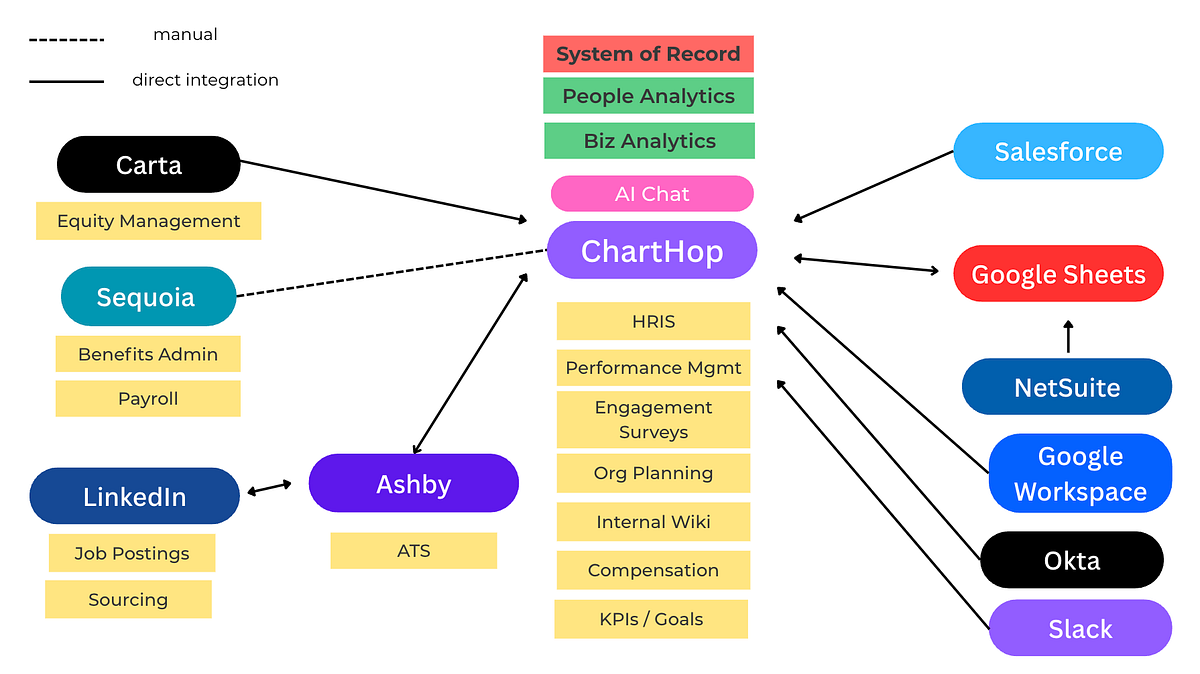
Since I made this map, we’ve actually added yet another layer; we are now sending Gong transcript data via an MCP (Model Context Protocol) to our enterprise Claude account. We consider this a temporary measure until we can integrate the Gong transcript data directly into ChartHop in real-time.
For more on why MCP matters for your HR AI Strategy, learn from my friend Nelson
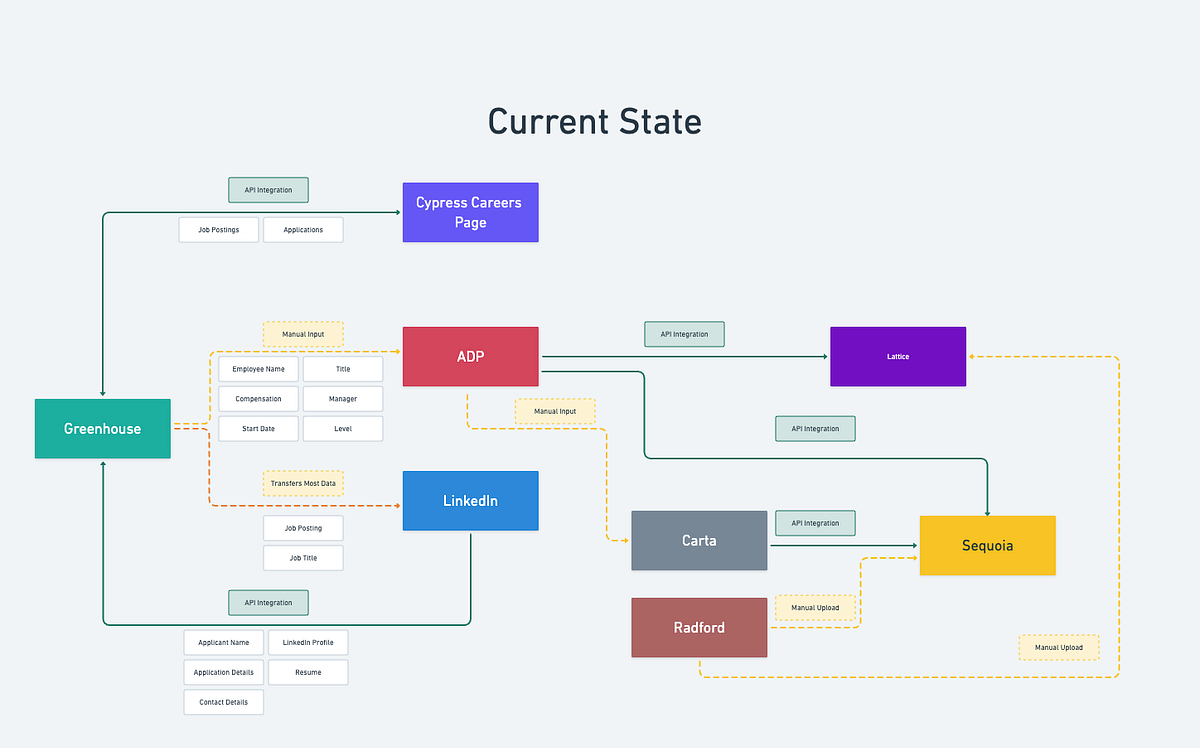
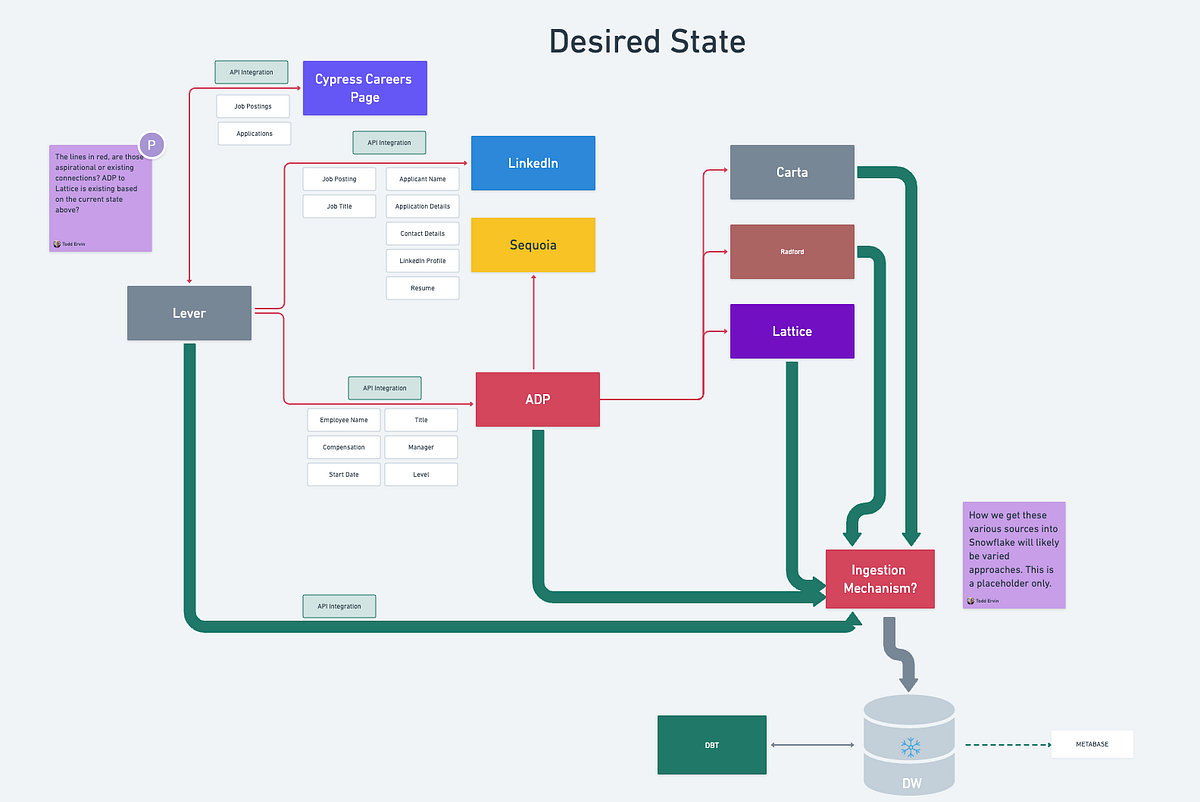
The difference is striking between both iterations of Cypress’ mapping and ChartHop’s is striking, I think on two levels. The progression of where we are today, at least within ChartHop is that we have a few major changes:
- Single source of truth AND a single source of data.
- People and business data live TOGETHER
- AI is layered on top of that data
All of these are important in cascading order; each one enables the next. The difference between what I can do now and what I could do three years ago feels like decades' worth of change.
Here is some of what I’ve asked our AI in ChartHop — (access to all people data — HRIS, payroll, performance, compensation, 1:1, feedback, client/sales data, and financial metrics/KPIs)
- How mature is our pipeline, and how does it compare to the same time last quarter?
- What modules does XYZ customer use with ChartHop?
- Can you do a review of our current organization, our roles, teams, functions, and goals, and assess where we could introduce AI to improve the success of these teams. Be specific in who or what teams would use it, what the tool is, why you think it’s successful and what the expected gain or efficiency would be using it.
- Can you review the performance of [X employee] over the past year?
- What is our product positioning?
- What are the three-year trends for caregivers across the org, and do we see any correlation with attrition or promotion?
- Based on engagement feedback, what kind of knowledge-sharing tools would the team find most helpful?
- What short-, medium-, and long-term actions should we prioritize based on the latest survey data?
- → Do those ideas align with our stated values?
- How are we trending against our current revenue goals this quarter?
In Claude, with access to the Gong transcripts, I am asking —
- Review the themes around needs presented in the last six months of prospect calls to understand their pain points?
- Review sales performance data to ascertain any trends from the past six months?
This has less to do with what products we are using (although this DOES matter for security, privacy, etc.) , and more to do with HOW we are using them and WHAT we can do with them. It’s transformed what data infra looks like and what the possibilities are for us. It’s leading me to a few last thoughts …
- Why don’t we talk about data infrastructure much in the HR community? In fact, I don’t think I’ve ever seen the visuals I’ve included in this post shared by anyone, ever? Data infrastructure is critical; it’s how we utilize the data we have access to, which is often the most vital asset for companies: their people. So why isn’t this a discussion we have more readily?
- How do we consolidate people and business data into a single data lake so that people data no longer lives in isolation from the business reality? I feel really fortunate that at ChartHop, we have access to so much business data, and I can use our AI to run analyses, both quantitative and qualitative. However, how do we shift the narrative to make this more normalized, and not just for large, public companies with the scale to justify it better?
The technology is finally catching up to the aspirations I had a few years ago, making it possible for smaller, leaner teams to gain insights quickly, connect more data, and build their business with purpose. There are many more things we could discuss in relation to data and AI (such as predictive bias), but the benefits of what we can do and see are meaningful.