One Year into Fractional: Behind the Scenes
It’s been a year since I officially launched my fractional consulting business. Wow, what a year it’s been. Below, I’ve broken down how I…


It’s been a year since I officially launched my fractional consulting business. Wow, what a year it’s been. Below, I’ve broken down how I run my business behind the scenes, from AI tools to taxes. I’ve organized everything alphabetically by category to make it easy to navigate.
Table of Contents
Accounting & Taxes · Admin · AI Tools · Benefits · Branding/Website · Business Development · Compensation · Corporate Entity Setup · Expenses · Pay Structure · Revenue Streams · Tech Stack
Accounting & Taxes
I use QuickBooks for accounting, payroll, and my business checking account. I manage most of it myself: sending invoices, tracking expenses, and paying myself and subcontractors. My accounting firm conducts monthly and quarterly audits to identify any errors and handles year-end tax preparation.
I don’t have a business credit card, so I track expenses using Monarch, which I also use for personal finance. I pay about $5K annually for these services plus they also prepare my business and personal taxes too. I’m on my third tax & accounting firm.. finding good vendors in this space has been hard.
Admin
I manage scheduling, travel, expenses, and general admin on my own. I started my career as an executive assistant, though I’ll admit I wasn’t the best one (sorry, Rob). These days, I use Google Calendar integrations and Calendly for meetings. Weekly calendar reviews are crucial, which I typically conduct on Sundays. However, lately, it’s been a bit chaotic, and I’m considering part-time help (sorry to anyone I’ve had to reschedule or accidentally double-booked lately).
AI Tools
- ChatGPT, Claude, Perplexity: I build project folders for client work and personal areas. I use these for content reviews, gut check on employee situations, legal questions by state, and more. I don’t put any client or employee data into these platforms, so anything I share needs to be general or anonymized, unless it’s a client-specific license.
- ChartHop AI: This is our internal AI chat at ChartHop (where I’m fractional VP of People). It integrates with Salesforce and NetSuite, and pulls in other business data; and it’s our system of record for people data. We have an AI chat that has access to anything in the platform I have access to (which as an HR Exec/Admin is everything). This allows me to run analysis, crunch data, provide summarization on everything from performance in real-time, potential employee issues, understanding gaps or misses business goals, etc. It’s backed by a widely used AI platform so it operates like a ChatGPT or Claude would. I wish I had this with all of my clients because I don’t have to go through the steps of deanonymizing data or not being able to upload biz data into the AI platforms. I could (and maybe should) write a whole other blog post just on AI for HR.
- Grammarly: For all writing and content polishing.
- LaunchLemonade: Multi-model AI access. Still evaluating how useful it is, but it has access to all of the LLMs out there.
- Lovable: No-code website tool. If you like Squarespace, it has a learning curve; if you like more control and are technical, it’s great.
Benefits
- Health Insurance: Covered through my partner’s employer plan, which is a massive savings in headaches and cost. I am very fortunate to have a partner with a full-time job and the benefits that come with that.
- Disability Insurance: I pursued private short- and long-term disability coverage due to my chronic health conditions, but was denied coverage. So I’m relying on MA state benefits if ever needed.
- Parental Leave: As I plan for family expansion, I’ve budgeted for six months of no income to cover the pregnancy and postpartum period. If I were in-house, this wouldn’t be a personal financial burden.
Branding/Website
I spent about $3K on my branding and website. First, I used Squarespace. My latest site is built on Lovable. Here’s who helped me get to where I am:
- Emily Miles: Offers creative, branded builds on Squarespace and marketing strategy, content, and more. Emily and I went to college together, and she’s a wonderful friend and human.
- Nelson Spencer: Focused on technical and AI-enhanced site design via Lovable. Nelson also does AI for HR consulting too. I met him through PeopleTech Partners, and he’s quickly become someone I really respect and appreciate greatly. He’s a thoughtful partner and expert.
As a former artist and designer, my brand aesthetic matters to me. This took a few iterations to get right.
Business Development
I don’t have a steady stream of people reaching out to me. I’ve had a few limited inquiries or connections that've landed. Here are a few examples:
- B/SPOKE (Boutique Fitness, privately-owned): I joined as a client nearly 10 years ago and at some point they were looking for HR support on an ad-hoc basis. I did light advisory work for about 7 years before moving into a part-time Head of People role in October of last year. >> through personal interests
- Cambly (Edtech, SaaS, post-Series B): My dear friend reached out in early 2024 looking for some new client work. That same week I happened to see a post on the Bessemer People leader forum of someone inquiring about part-time/temporary people leader. It was the first I had even replied in that forum and the fact that I even saw it was fairly random. I gave them my friends details and a few months later she decided to take on a full-time role for the first time in 7 years. That same client still needed support so she referred me and I got the role. I’ve been with them for the past year but am winding down my support. >> through professional VC forum
- ChartHop (HR tech, SaaS, post-Series C): I couldn’t attend their Transform session on their HRIS product, so I reached out to see if I could learn more in another forum. Their CEO, Ian, reached out and we chatted about the platform, future of HR tech and much more. Their People leader gave notice days later, and I applied via a referral post from Shelby Wolpa in Fractional People People. >> Network/PTP/Fractional People People
- Cypress (Devtools, SaaS, post-Series B): My former employer. I shifted from full-time to fractional, focusing on executive partnership, finance, and recruitment coordination.
- Projects: Ongoing work with Fidelity (via a friend’s consulting firm) and a SOC 2 review project with a tech company. >> network/referrals
Point being here is I haven’t actually landed any work by someone reaching out to me via my website. I actually have never even received a real inquiry that way. I don’t have hardly any volume at all. It’s just the opps I do are meaningful and real, and lasting.
Proactive Prospecting: Before landing ChartHop, I built a Crunchbase Pro dashboard to identify Series A/B software companies with more than $10M in funding in the last year.
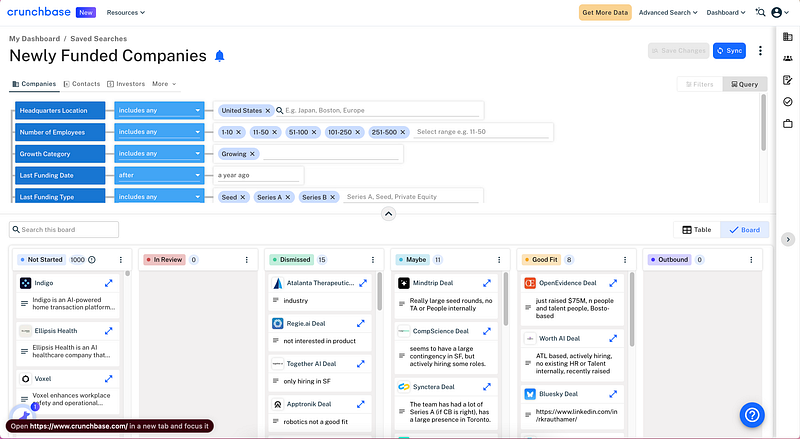
Criteria included:
- US-based
- Headcount under 500
- No internal HR leader listed or visible
- Actively hiring
- Remote-friendly
I tagged each company and researched the best point of contact — usually founders or COOs. I only got to outreach with a few before ChartHop came through, so I was almost a little bummed I didn’t get to fully try this out.
Compensation
I’m transparent in 1:1s, but prefer partial public transparency. Here’s the general picture:
- In 2024, I earned 60% more than I did as a full-time W2 (pre-expenses).
- In 2025, this is expected to be closer to 50% due to changes in the client mix.
Rates:
- Tech clients: $225-$250/hour
- Non-tech clients: $150-$175/hour
- Off-sites/workshops: $300-$500/hour
If I needed health insurance, it would be a huge expense that would eat into my revenue, which I currently do not have. On the flip side, if I weren’t planning for parental leave, the income increase would feel more generous. Either way, I feel very fortunate and privileged.
Corporate Entity Setup
I operate under an LLC taxed as an S-corp. This means that I have an LLC through which all of my income is funneled, and then I set a salary for myself. And then I have a profit distribution I take based on how much I make that year. I take this profit distribution monthly, but I could take it whenever I want.
My salary is $65K/year (subject to both employer and employee taxes), with profit distributions taxed once. I file estimated quarterly taxes and manage the rest through QuickBooks, which is automatically filed as part of my payroll. My salary is disproportionately lower than my profit distribution.
I left my Cypress income as W2 this year to avoid setting up a solo 401(k). I’m maxing contributions via their plan instead.
Note: I’m not an accountant — get one you trust before setting up your structure as everyone’s situation is very unique and different.
Expenses
Accounting: Monthly/quarterly audits, year-end taxes ($5k/year)
Website/Branding: One-time spend ($5k)
Education/Travel: as I need/want
Software: Fathom, Google Workspace, Notion, etc. ($350/month)
Paid Communities:
- OpenOrg: $22/month
- Fractional People People: $120/year
- TroopHR: $600/year
- Syelo Ventures: $1,000/year
Pay Structure
I generally prefer hourly billing. It helps me maintain clear boundaries and accurate compensation for the work I do. Some clients prefer retainers, which I’m open to under certain terms. I invoice monthly in arrears and have always been paid (yay!).
Revenue Streams
Effectively, all of my revenue is generated from fractional and embedded client engagements. I don’t monetize content, referrals, coaching, or paid 1:1s.
I occasionally bring in trusted partners, such as Brit, Victoria, and Taryn (y’all are the best), to meet client needs. I don’t mark up beyond covering payroll platform costs. I want subcontractors to earn what they deserve and value the partnership. It benefits me to have someone I can trust bring expertise to my clients.
Schedule
I don’t set specific working hours or days. I’m just available, and responsiveness hasn’t been an issue. I tend to have what I would consider to be a flex schedule. This means I don’t work a typical 9–5. I set my personal schedule for doctor’s appts (of which I have many), and anything that helps keep me healthy (fitness classes, walks, acupuncture, etc.). What this tends to look like is that right now I’m usually working 40 hours a week, but a sample day might look like this:
8am-10am: walk my dog, breakfast, catch on emails, get ready for the day
10am-3:30pm: meetings/work
3:30pm-5:30pm: fitness class, shower, drive back and forth
5:30pm-8:00pm: dinner, relax, write, walk my dog
8:00pm-8:45pm: meeting
Every day looks pretty different; I take calls on my drives to and from working out, doctor’s appts, errands. I work remotely for most of my work, but I go on-site with B/SPOKE to attend meetings or when we have a studio launch, off-sites, or other engagements. I love this and it breaks up my day and work from home.
Tech Stack
- AI Tools mentioned above
- Canva: Visual design
- Calendly: Scheduling
- Crunchbase Pro: Prospecting
- Google Workspace: Email, calendar
- QuickBooks: Accounting & payroll
- Notion: Notes
- Lovable: Website
- Fathom: Website analytics
- Medium: Content platform